AI-First GTM Team — Reference Architecture | Bowtie Funnel
Reference Architecture · Bowtie Funnel Labs

The AI-First, Multi-Engineer
Headless GTM Team

GTM automation, shipped the way software teams ship code — version-controlled, tested against evals, previewed in isolation, and promoted through staging into a governed production engine. Here is the full pipeline, layer by layer.
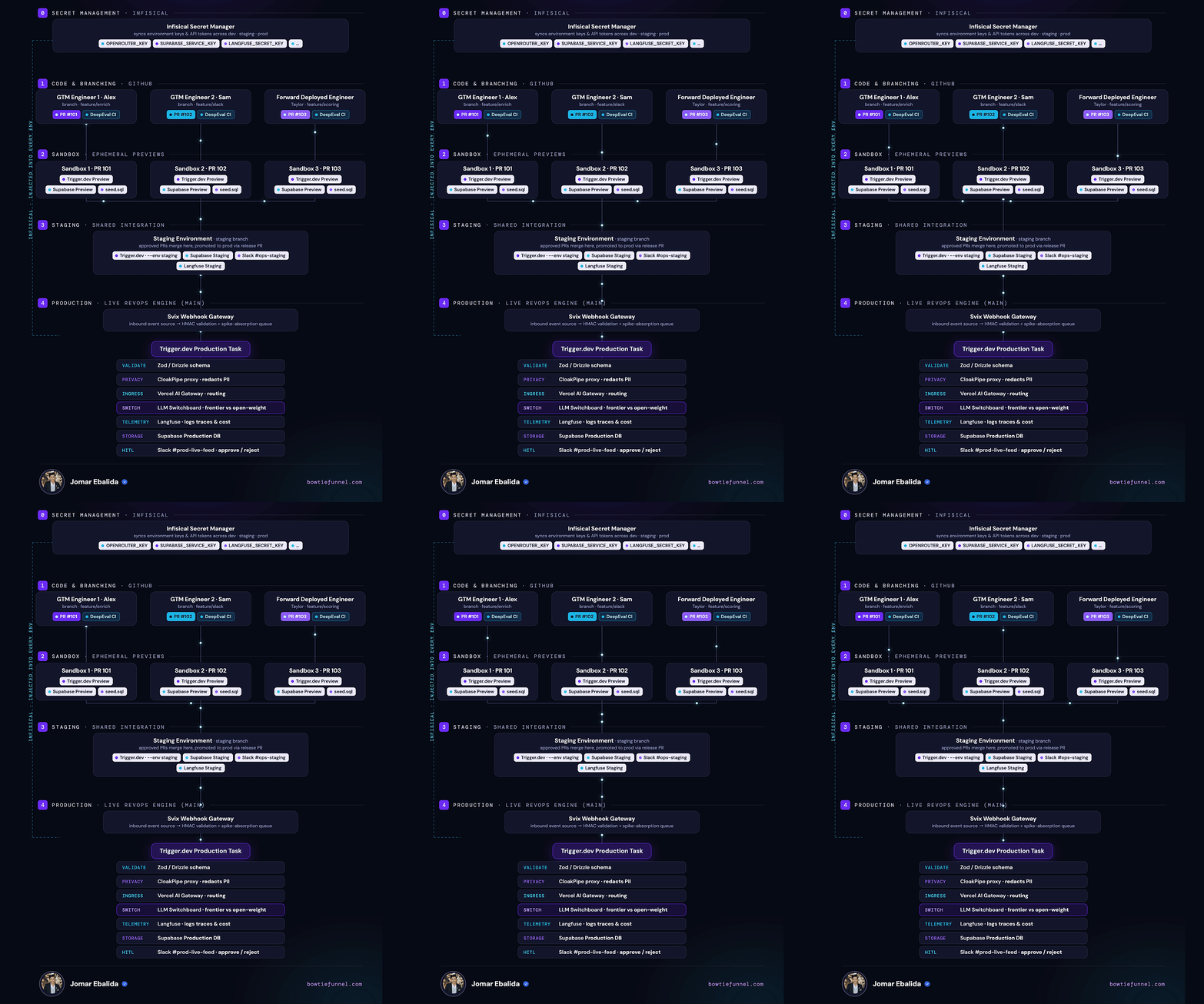
AI-First GTM pipeline: secrets → branches → sandboxes → staging → production

Live pipeline · secrets → branches → sandboxes → staging → production

The AI-First GTM Team Blueprint

The full System Blueprint & Change-Management doc — architecture, migration path, and a readiness checklist. Enter your name and email; the PDF opens instantly.

Here's your Blueprint 🎉

It's opening now, and a copy is on its way to your inbox.

Download the Blueprint (PDF) →

The five layers

Every layer has one job. Together they let several engineers ship to the same GTM engine without stepping on each other — or on production.

0

Secret Management Infisical

Environment keys and API tokens are injected into every environment — dev, staging, and prod — instead of living in code or a shared doc.

1

Code & Branching GitHub

Each engineer works on their own branch and opens a pull request. Every PR is gated by DeepEval CI, so model behavior is tested before it can merge.

2

Sandbox Ephemeral Previews

Each PR spins up its own Trigger.dev and Supabase preview, seeded with data — an isolated copy to test against before anything touches shared environments.

3

Staging Shared Integration

Approved PRs merge into a shared staging environment for integration testing, then get promoted to production through a release PR.

4

Production Live RevOps Engine

A Svix webhook triggers a production task that validates the payload, redacts PII, routes and switches models, logs traces and cost, writes to the database, and pauses for a human on the calls that need one.

Questions, answered

What makes a GTM team "headless" and "AI-first"?
Headless means the GTM automations are built and deployed like software — in version control, behind pull requests, running on infrastructure — rather than clicked together inside a no-code tool. AI-first means language models are first-class steps in the pipeline, governed with the same rigor as the rest of the stack.
Why does every pull request get its own sandbox?
Isolation. A per-PR Trigger.dev + Supabase preview, seeded with data, lets an engineer exercise their change end to end without touching a shared environment or another engineer's work. Bugs surface in the sandbox, not in staging or production.
How are secrets and API keys handled across environments?
Infisical holds the keys and injects the right values into each environment at run time. Nothing is hardcoded in a script or pasted into a config field, and rotating a key updates every environment from one place.
What is DeepEval CI checking before code merges?
It runs evaluations on the model-driven parts of a change — the way a test suite runs on ordinary code. A PR that regresses output quality fails the check and doesn't merge, so model behavior is gated, not assumed.
What happens to a single inbound event in production?
A Svix webhook validates the event and absorbs spikes, then hands it to a Trigger.dev task that runs the fan: validate the schema, redact PII, route through the AI gateway, switch to the right model, log traces and cost to Langfuse, persist to Supabase, and post to Slack for human approval where it's required.
Is this overkill for a small team?
No — it scales down. One engineer can run the whole loop on day one; the sandboxes, staging gate, and evals are what let you add engineers and agents later without the reliability falling apart. You adopt the layers you need and grow into the rest.
Scroll to Top